The Voynich GardenTM online application presents the remarkable plants depicted
throughout the Voynich Manuscript for easy browsing and identification.
Digital images of all 124 whole plant illustrations found in the manuscript are depicted in the rolling gallery.
Any one of these can be selected to view an enlarged image for inspection. We welcome and encourage you
to propose identification of the plants, and to add your vote and comments on any of the plant identification proposals
displayed in the accompanying table.
Digital Images
These digital images have been derived
from
high resolution images of the manuscript that
have been made available by the
Beinecke Rare Book and Manuscript Library at Yale University.
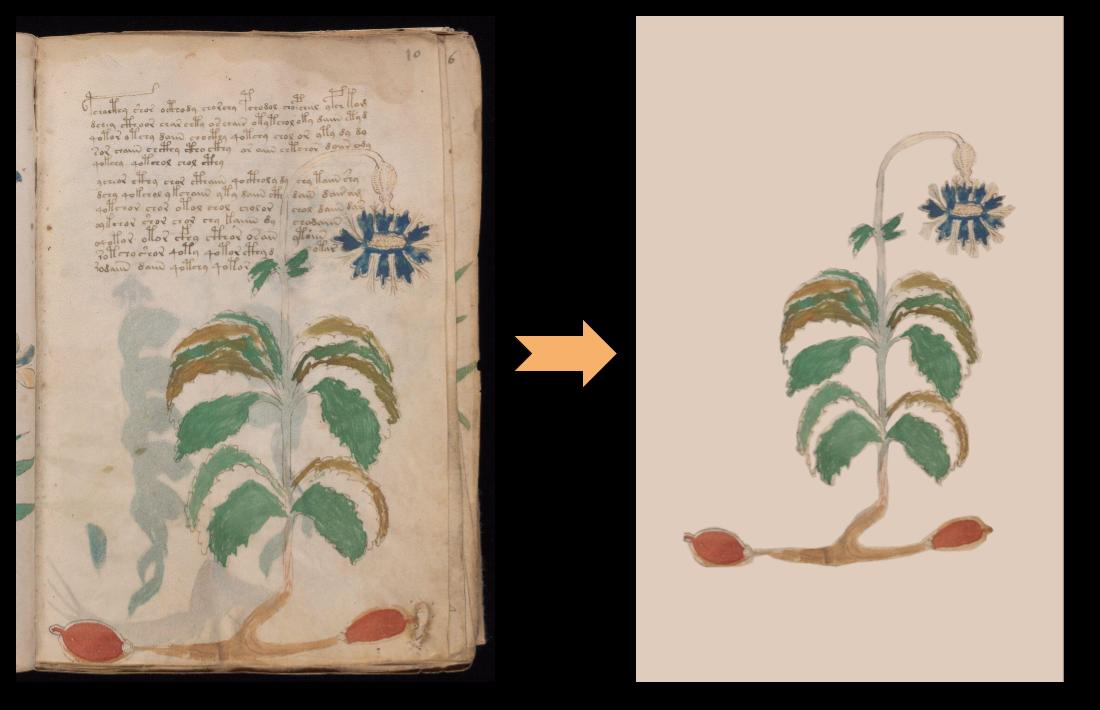
Each plant has been carefully clipped, cropped, and
remounted. We believe the clean image of just the plant -- without the distractions of
the accompanying script and shadow images (caused by ink transferred from adjacent folios) --
provides a
clearer impression of the artist's orginal work and makes it more likely that someone might
recognize and identify the plant.
Plant Reference System
The plants are referenced by the folio page of the manuscript on which they are located.
Each of the 116 folios of the manuscript has a frontside page, termed "recto" (i.e. front and right-hand), and a
backside page, termed the "verso" (i.e. back and left-hand). The conventional reference system for the
folio pages indicates both the folio's ordinal number and its side (e.g. f8v or f27r).
While almost all illustrations of
of the whole plants are found alone on their own page, there are a few pages that contain more than one whole plamnt.
So we have appended an additional numeral to the folio page reference to differentiate each plant (e.g. f27r.1 vs f27r.2).
Pland ID and Consensus Scores
To gage the level of agreement aroudn the identification of each plant, we have included a Plant ID Score on each
proposed identification, and a Consensus Score on each plant. The Each of these scores ranges from 0 to 100%.
The more people agree (and do not disagree) with a particular proposed identification, then the higher its
ID score. And the more that there is agreement on a single proposed identification, then the greater the consensus
score for the plant.